
Rataquena Viewpoint, Regional Museum of Ancash, Wilcahuain, Ichic Wilcahuain, Lake Wilcacocha, Chavín de Huántar
In order to get from Lima to Huaraz, I had to take a bus I thought would take around seven hours, but in reality it took more than ten. It was a long and tedious ride, and because of the mesh-like screen over the windows, I couldn’t even see the view. After I got to Huaraz and checked into a hostel, I decided to take it easy and give myself time to adjust to the altitude, just in case.
When I headed out, I wanted to do it in a gradual way and start things off on the easier side. So I put my shoes on, and took a fairly boring walk through the town until I got to a dirt road where several colectivos were parked, and for me that marked the proper beginning of the trail to the Rataquena viewpoint.
From the very beginning of the trail I had great views all the way to the very end, which made me very happy. The views changed gradually over the course of the trail, revealing the town below and nature around it. The trail itself was pretty easy (although a bit muddy because of the trail in the previous night), didn’t require any special effort, and since the elevation felt pretty mild I didn’t worry about the altitude.
It took me about an hour or so to get to the cross which marked the viewpoint, and I sat there for a couple of minutes to drink some water, have a little snack, and enjoy the view that didn’t disappoint me. From there the original plan was to keep going to a second viewpoint, but I felt it was enough for me and went back to town, this time taking the colectivo.
At the center of Huaraz there wasn’t much to do, and the only thing that really had my interest was the Regional Museum of Ancash. The entrance had some faces carved into stone, and the signs mentioned the Recuay people who lived in the area and made them. I didn’t understand all of it (it was only in Spanish), but that part I did understand was interesting.
Then I moved on to another room, which had more general information about the Recuay, as well as other cultures and civilizations who lived in the area, all the way to the time of the Inca empire. There were also mentions of a couple of historical sacred sites, and at the very end was a small section dedicated to Chavín de Huántar, a place which I intended to visit during my time in Huaraz.
The second floor of the museum had a few small areas, talking about different aspects of life in the Ancash region at the ancient times, such as art, music, and war. At the ground floor there was a gallery which was more about clothes and fashion, and after that I went straight to the garden, where many of the carved faces and sculptures were on display. I had a nice look around, and then I left the museum and went back to the hostel.
After the regional museum, it was time to go and visit the ancient archeological sites in the area. Relatively nearby, about an hour away with the colectivo, was the site of Wilcahuain.
I wasn’t sure what to expect, as I didn’t educate myself beforehand about the site, but I was looking forward to learn. It was smaller than I expected, and consisted of one main building, a smaller building next to it (with no access as far as I could tell), a gallery, and a bathroom. Since I was the only one there, I was free to explore the site without anyone getting in the way.
I started with the main building, which had three different entrances. I took a look around it first, and then entered it from the side. I had to duck down for a moment due to the low ceiling, but it only took a few steps inside before I was able to stand up. It was a pretty small room, and not very impressive, so I made my way out pretty quickly. The second and third entrances were more of the same, with a small difference in the layout. I felt like I was missing some important contest regarding Wilcahuain, and there was no guide to offer assistance in the matter.
When I entered the small gallery, I found the information right there, on big signs across the walls, with a few items on display in the middle. It was a pleasant surprise to find out that the signs were in English as well, which was unexpected yet very welcome. It was dated to the time of the Wari empire, which originated in Ayacucho, and had importance to the Chavín people. From what I gathered, the main building was more like a mausoleum, most likely for the elite and the nobles. The three different entrances were because the different rooms served a different purpose, but it was all pretty much to do with death.
Upon exiting the site, the guard at the entrance told me that with the same ticket I can go to another site, Ichic Wilcahuain, which was about ten minutes walking from there. I was planning to go there anyway, and it was nice to find out I don’t need to buy another ticket for it. According to one of the signs in Wilcahuain, “Ichic” was supposed to be small, but when I got there it looked and felt bigger than the main site.
There was no gallery this time, but there were more buildings, and some signs next to them. They more or less iterated on what I came across in the main site, but they had a few additions, pointing out specific areas in the complex other than the main building. Of course, I entered this one as well, and had to use the smartphone to light up some parts of it which were pitch black. This site felt a bit more adventurous, although the rooms I could get into were still pretty small. I took a good look around, admired the view around me, and headed back to town.
Although I was planning to visit Chavín de Huántar next, it proved to be more complicated than I thought. Instead, I decided to embrace the nature of Huaraz. I wanted to take it a bit slow and gradual with the altitude and the fitness level, so I started with Lake Wilcacocha, which was the lowest of the lakes I planned to visit, and easily reached with public transport from the town.
I was dropped off at the starting point after about half an hour, crossed a bridge, and started the hike. The road wasn’t super steep, but there was certainly an incline that added to the challenge. Some of it must have been due to the altitude, but for me it was mainly the angle. It was a dirt road almost the entire way, and some parts of it were quite muddy and required slow and careful navigation. Other than that, there weren’t any serious challenges.
All along the way I had great views to look at, which got better and better as I climbed on. At first it was the river, then all the greenery around it, and as I got higher up I could see the snow-capped mountains in the horizon. Surprisingly, there were quite a few houses along the way, and quite a few of them had animals roaming around, which gave the experience a bit of a rustic and rural vibe.
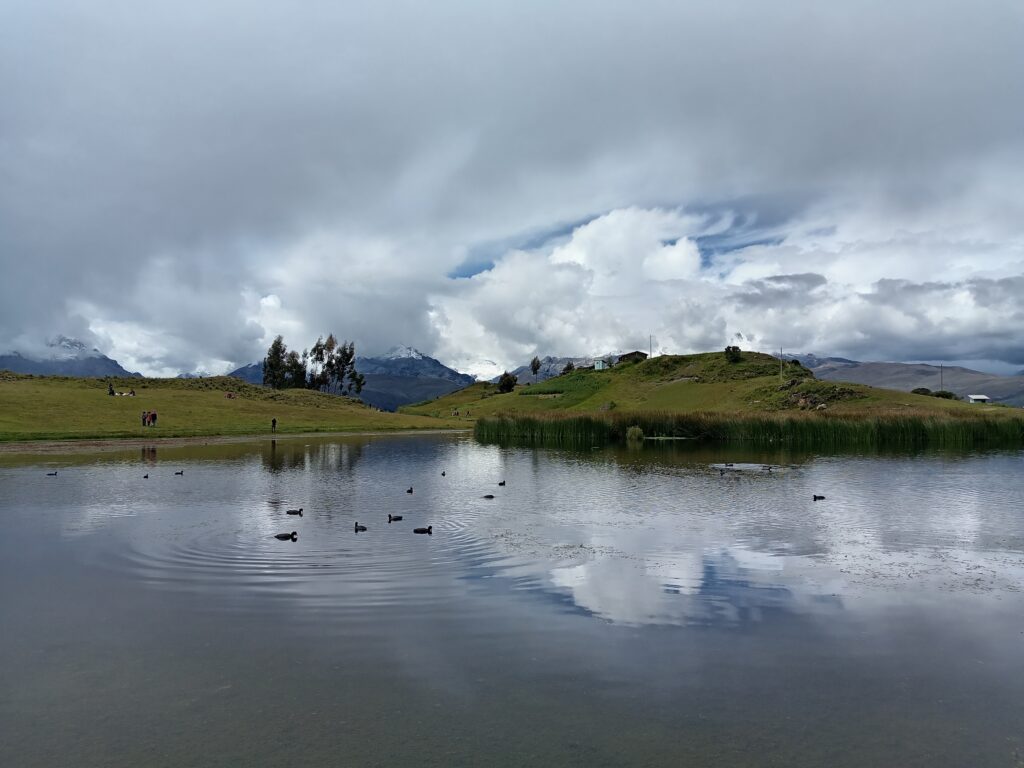
Then, when I wondered if it would take as long as the map indicated, I went up some stairs, saw a family sitting right at the top, and knew it had to be the end. I climbed the few remaining stairs, and was greeted by the unimpressive Lake Wilcacocha. I was told to expect it, and so the sight wasn’t all that disappointing, especially after enjoying the road over there so much.
Instead, I turned my attention to the view from that point, which was spectacular. All around there were trees, grassy hills, and mountains. In the distance, the snowy mountains looked almost royal in their appearance, and I sat down to rest and look at them for a while before returning to Huaraz.
Since I couldn’t find any English speaking tours that go to Chavín de Huántar at a reasonable price, I looked around a bit more and found a public bus that goes there. I didn’t really know what to expect, and it wasn’t clear if the ticket I bought was a return ticket or just one way, but I didn’t really have other options.
The ride started and I took a little nap for about an hour. When I woke up, the scenery changed quite a bit. There were green hills to look at, and gradually those hills turned into mountains, more brought than green, a striking sight against the partially cloudy sky. What I didn’t realize early on (and googled later) is that the road to Chavín de Huántar passed straight through the Huascarán National Park, and the views there were absolutely jaw-dropping. We also passed a lake along the way, but it wasn’t a scheduled stop. Nevertheless, I found it difficult to not smile with all the beauty around me. That ride along was worth the money.
The bus stopped near the market in the city of Chavín de Huántar, which was about half way between the archaeological site and the museum. I found it confusing (and a bit annoying), but complaining about it wasn’t going to help. Since I’ve seen a comment mentioning it on Google Maps, I decided to go to the museum first.
In the beginning there was a gallery that was dedicated to women in South America, talking about their achievements in various fields, such as art, sports, and politics. I didn’t really understand why it was in a museum dedicated to Chavín, and after a quick look around I moved on.
The rest of the museum was more about the history, theories, and findings in the archaeological site. There was very little in English, and I tried my best to understand the Spanish signs, with which I had partial success. At the end I felt like I only learned a little bit, and hoped the visit to the ruins themselves would help me understand things better.
As it turned out, it didn’t. The site was a lot smaller than I expected, with almost no signs to explain anything. The signs that did exist were available in both Spanish and English, which made things easier, but it simply wasn’t enough. I toured the site in about half an hour, which included the underground sections. I felt like a guide was necessary in this place, and without it the educational experience is practically non-existent.
However, the view from Chavín de Huántar was amazing, less than the view from the road but still worth it. The only problem I had the entire day was on the way back, where I found out the ticket was only a one way ticket. I didn’t end up saving much compared to going with a tour, which would likely be a better experience for anyone who has a very good level of Spanish.