
Los Cocos Bahia Beach, Tayrona Gold Museum, Pedagogical Carnaval of Santa Marta, Taganga Playa Grande, Playa Escondida, Barranquilla Carnaval, Barranquilla Carnaval Museum
Transitioning from Central to South America, I had to choose if I wanted to travel by air or by sea, and I chose the former. It was easier, cheaper, and faster, and I needed to rest. Crossing the border from Panama to Colombia, my first stop in South America, was the most straightforward border-crossing experience I had up to that point, and leaving the airport was just as simple.
But just as quickly, a few problems came up, pretty much immediately upon getting to Santa Marta, where my Colombian adventure was going to start. First, I had to bounce around between a few hostels until I found one that I liked, which of course required more money (but was still at a good price for me), and all of the places I checked into did not have a water dispenser. Then, when I went to get a SIM card, I thought it was a bit expensive, and upon talking to other backpackers it seemed I got ripped off. And the first place I stayed at didn’t have a kitchen, so I had to go out to eat, which was not cheap.
Thankfully, after a few tiring days I did find a place that I liked. It wasn’t perfect, but it was good enough for me to finally be able to start relaxing and get the rest I needed. After a few days of not really doing much, I wanted to go to the nearby Taganga. I was hoping to go by foot, as the distance wasn’t great and the road passed by the coastline, but it was deemed unsafe, and instead I just went to what was marked on Google Maps as “Los Cocos Bahia Beach”, which was a decent beach, although without anything special about it.
Going for a more educational experience next, I paid a visit to Tayrona Gold Museum, which was free, and not really about gold. There were several galleries in the museum, which spread across two floors. The first one I entered, as instructed by the security guard, was about the pre-Hispanic people who lived in this area. It had a good amount of details and was fairly informative, which I quite liked. Of course, part of this information was about rituals revolving around death.
There was also a gallery dedicated to metalwork in general, not just gold, with quite a few times on display. It all felt familiar, yet still different, and I started to wonder if I’ll ever get to a point where it all feels the same and gets too boring. At some point, maybe, but not at that particular time.
The second floor got me confused. It started with a large, mostly empty room, with a mention of Simón Bolívar. To the left there was a gallery which actually was about the man, and his great importance to South America and to Colombia. A big part of it, the timeline, was only in Spanish, so I only focused on the few signs that were in English.
The confusing part came next. I found myself in what seemed to be a general history gallery, without a clear idea whether or not I was supposed to start at a particular point or move in a certain direction. At this point I also started to feel tired, and within a few minutes decided I had enough for the day and went back to the hostel to rest.
Next I planned to visit the beaches of the nearby Taganga, but upon leaving the hostel I could hear loud music, which grew louder as I got closer to the main street from which I was going to take the minibus. When I got there, I saw what appeared to be a parade.
As I watched it in confusion, being quite confused about what was happening, rows after rows of dancers were marching along. After several minutes some more dancers came over, with two of them holding a sign indicating this is the “Pedagogical Carnival”, and I didn’t really know what the first word meant. I figured it was more local, and for me it was like a sample of the Barranquilla Carnival, which was supposed to take place only a couple days later.
Since some streets were temporarily clogged, and I would have been stuck sitting in a minibus that barely moves, I spent some time just watching this carnival taking place, following it for a couple of streets before going back to the main road once it was clear.
It took less than twenty minutes for me to get to the stop at Taganga, which was marked on the map as a beach but in reality served as a marina for all the boats that took people to other beaches in the area.
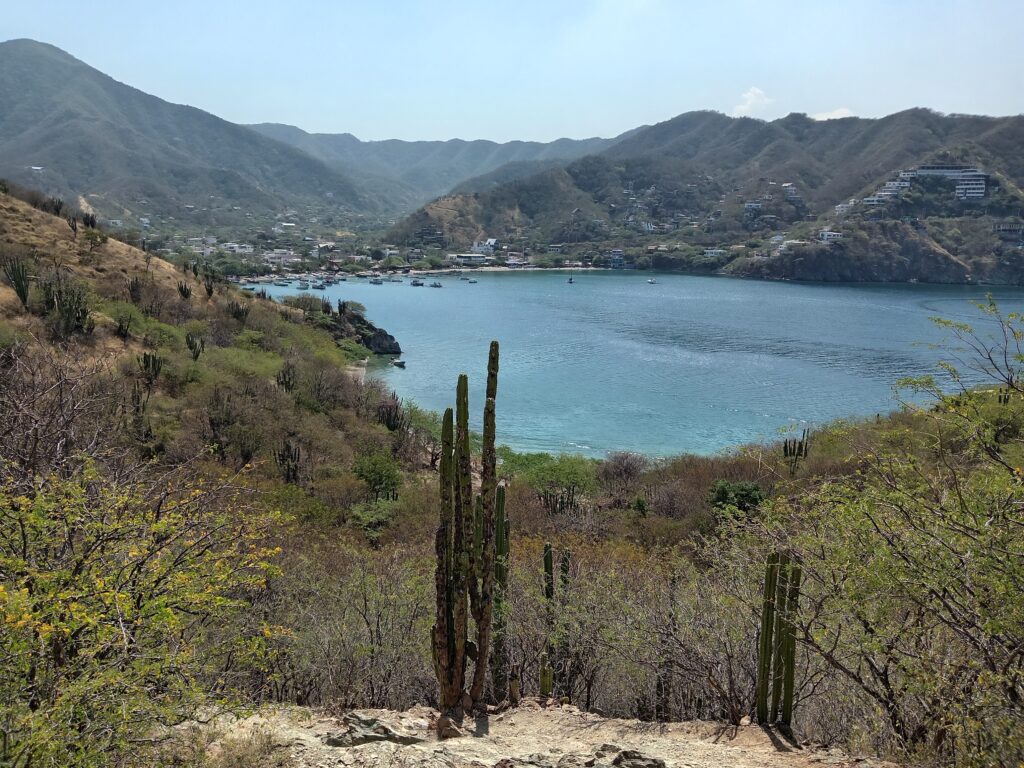
I, however, was not interested in a boat ride, and instead opted to take a walk along a beautiful coastal road with a great view of the area. It seemed to be that most people opted to take the boat, which I didn’t really get, since the road I walked along was easy and not very long. It took me a bit more than ten minutes to get to “Playa Grande”.
It was nicer than the beach in Santa Marta, although not by a whole lot. I assumed all the chairs spread around the beach were not free, and before trying to find a spot where I can put my stuff and go into the water, I decided to just walk across the beach and see all of it. It didn’t take long, only a couple of minutes, and when I got to the end of it I found a new trail, leading to another beach.
I had both time and curiosity, so instead of getting into the water I went forward, walking along yet another coastal road with views that were just as beautiful as the first one. On my smartphone, along that trail were a few more beaches to get to, and I thought it would be nice to see all of them, especially since I had no idea if I’m coming back to the area.
However, about five minutes after I started the trail there was a split in the road which made me stop. That side road was leading down to the beach, to what appeared to be a completely secluded area. It was tempting, and I decided to take it. A couple of minutes later, I was in a miniature cove all by myself, completely hidden from views of any beach. The water was cold and calm, and I felt some inner pressure being released for the first time in a while. Not only did I enjoy it, but I needed it.
After about fifteen minutes or so, I got out of the water, dried myself a bit, and went back to the main trail, heading toward another beach, which Google Maps marked as “Playa Sisiguaca”. The road over there was slightly more rough, but didn’t present any challenge. Soon enough I was at a beach that also had a firepit of sorts, which was used for cooking (for anyone willing to pay for it). Since it was smaller, it didn’t take many people to make it feel crowded, and after taking a quick look around I went back to the trail and pressed onwards.
The road itself didn’t change much, all the way up to the point where I made a wrong turn. Within a few minutes I found myself along a steep road which was a dead-end, and along that road I mistakenly placed my hand on a very thorny branch, which caused me some pain for a little while.
I turned around, spotted someone who was going in the right way, and followed his steps all the way down to what was called “Playa Escondida”. It was small, and with only a few people in it, so I still was able to find a spot for myself. For me, that was the end of the road. I stayed there for a while, swimming and enjoying the sun before I decided I had enough and made my way back to Santa Marta.
Going to Barranquilla for the day, I took the MarSol minibus. It was easy to find, and although it didn’t leave at the time it was supposed to, I was lucky enough to get to the stop at Santa Marta just when it was about to leave. It took a bit under two and a half hours, and when it finally stopped, things felt wrong. It was very quiet, and when I looked at the map it also seemed pretty far from everything.
I never really experienced a carnaval before, which is the main reason I wanted to try it, although I wasn’t sure what it was that I was going to try. Fueled by ideas from the internet, I expected the Barranquilla Carnaval to take place all over the city, with dancing and music that can’t be ignored. I expected to see what I’ve seen in Santa Marta only a couple of days earlier, but on a much grander scale. According to the internet, it is the second largest carnaval after the one in Rio de Janeiro. But when I was dropped off at the MarSol stop, I saw none of that.
Being a bit confused for a while, I first checked when there was a minibus going back to Santa Marta, and then headed to the first bus stop that I spotted. There I asked a man how to get to the “malecón”, which was close to the road where the main parade was supposed to take place. He was a bit confused at first, which made me confused as I thought everyone in the city knew about the carnaval, and its location within the city.
Eventually the man managed to direct me to another bus stop, where I met a more helpful man who took the same bus as me, and when we left the bus, explained to me how to walk the remaining short distance to the main parade of the carnaval. I thanked him and started walking, wondering why it is still so quiet and there aren’t many people. The few people that I did see were just going about their day as if no special event was taking place in Barranquilla.
Then, eventually, I started to see more people, most of them merchants setting up their stalls for food and drinks. There was no music yet, and no dancing, but it was a sign I’m getting closer. A few more minutes of walking passed by, and I got to the end of the road, which was a gate to one of the more exclusive areas and required a ticket.
I had no desire to buy one, so I made a right turn and walked along until I found a free entree point, and it dawned on me that the celebrations of the carnaval in that day had yet to start. Without a clear plan, I walked around the place, watching all the workers going about their business, until I spotted a European couple talking to one of the staff members. I asked them if they knew when the day’s events were supposed to start, but they had no clear answer.
Together, we crossed the road and found a place to sit down and wait. And we kept waiting, and then waited some more. Occasionally there were a few people dressed up in costumes walking by, but they moved away pretty quickly, and once they did it was back to waiting in silence. I started to think how much more I’m willing to wait before giving up on this thing and just leaving. This was not something I expected from “the second largest carnaval in the world”. We waited for about two hours before anything happened.
And when it finally did, it wasn’t great.
First there was the ambulance, driving slowly across the road, and behind it were the different groups of the parade. It was a good sign. The first group, right behind the ambulance, was full of people wearing colorful costumes, although they didn’t dance much, and their music was mainly drums. Then they got past me, and it was quiet again.
Not too far behind them was another group, who did dance to pretty much the same kind of music, before moving past just like the first group. The third group was more lively, and just as I could feel myself starting to get into it and enjoy the carnaval, this group too has moved on.
That pretty much set the tone for the day. Group after group went by, at times with gaps so large between them that they could fit another group in there, and the few moments of excitement were quickly gone. Drum music was the main thing, which might as well be traditional, but I expected more. Most people walked passed, with only relatively few actually dancing. And while the colorful costumes did draw the eye, it was simply not enough. The whole thing was slow, a bit sad, and rarely exciting. After less than an hour I left the place.
Before attending the Barranquilla Carnaval I thought I’d leave it with one of two possible thought in my mind- Either it would be absolutely amazing and get me hyped for the carnaval in Rio, or it would be way too much for me and make me feel like I should skip the carnaval in Rio. What I didn’t expect to think was: “I am SO bored!”
After the carnaval I spent some more time relaxing in Santa Marta, and then headed up north to Riohacha, with the hope of finding a group with whom I could go to Macuira National Park. Unfortunately, that didn’t work out, and after this fruitless detour I headed back down, to spend some time and explore Barranquilla after the carnaval.
My first stop was the Carnaval Museum. The first two floors didn’t have much information, from what I’ve seen, only the crows and dresses of the carnaval queens throughout the years. Other than some names and dates, there wasn’t much to learn there.
The third floor was the interesting one. There, the walls were covered in signs, a few screens, and some items on display. Unexpectedly, I found myself reading about ancient egypt. For a good few minutes I was confused as to why, and then came the first mention of the carnaval. From there on, it was a historic journey, of carnavals and festivals in general, through the middle east, to Europe, and eventually South America.
After the history lesson, came a part that I found less interesting, talking about different dances in the Barranquilla Carnaval, and I could not recall seeing any of them in the parade, except maybe one. At that point I also started to lose focus a bit, and not too far after that I was told the museum is closing soon (less than 90 minutes after it opened), and I got out. I planned to visit a few more museums nearby, but they were closed at the time, so after a fairly short stay, I decided to leave Barranquilla and move further down.