
Butterfly Park, Love Park, Huaca Huallamarca, El Olivar de San Isidro Park, Amano Pre-Columbian Textile Museum, Huaca Pucllana, The National Museum of Archaeology Anthropology and History of Peru, Larco Museum, Pachacamac, Natural History Museum
Hoping for better experiences, I took a flight to Peru. While originally I considered starting around Cajamarca, I didn’t find any direct flights from Colombia, and decided to make Lima my first stop in this country. There, too, I found myself struggling with accommodations, and then I got too tired and decided to stay in one place for a little while even if it’s not that good. On the bright side, the city itself was beautiful and I enjoyed spending time in it.
There were many parks and gardens spread around the city, with quite a few of them around the malecon, with a view of the ocean. According to Google Maps, there were several malecons dotted around, although to me it seemed it was all one long path.
Either way, my Peruvian adventure started along that coastal road, in an area called Butterfly Park. It was a nice place, with colorful flowers and a good view of the water, but surprisingly almost no butterflies. Despite looking around and trying to spot them, I didn’t see more than a couple, who quickly moved away from me.
I then kept going along the coastal road, enjoying the views and the calm environment, until I reached Love Park, which had a statue of a couple kissing, and nothing special other than that. I stayed there for a brief moment, taking another look at the ocean, before I turned around and went back to my accommodation to get a little rest.
On another day, I wanted to see some ancient ruins, and so made my way to Huaca Huallamarca. It was a pretty small place, which had a gallery with a few exhibits and signs that provided necessary information about the items as well as the place itself, and a relatively small pyramid (compared to what I’ve seen in Central America). Both parts of the sight were somewhat interesting, but there was simply not enough there to make it feel special.
I wanted to see Huaca Pucllana next, but unfortunately it was closed. Along the way, I did pass by El Olivar de San Isidro Park, which was green, with lots of trees around and a couple of nice ponds. It was a nice stop along the way, which I was happy I got to see.
Not far from there was Amano, the museum of pre-Columbian textile. The entree fee was quite a bit more than I expected, but it was recommended to me, and I wanted to learn something about the ancient civilizations who live in the area, so I went in. The whole place was quite dark, and although for the most part there were a few lamps that allowed people to look at the exhibits and read the signs, it was a bit annoying.
There was a lot of information spread around the museum, about many cultures I have never heard of. I thought it would be mainly about the Inca, with some mentions of the Nazca, but it was quite a bit more. It wasn’t just about textile, either. Although it was obviously the main theme, there was also some general information about different cultures, what part of Peru they lived in, and when.
Unfortunately, I found myself getting tired again, and didn’t pay attention to everything. I have visited a few textile museums in Central America, and compared to them, the one in Lima was the best I’ve seen so far, although it had also cost more.
Then, once it was open again, I went back to Huaca Pucllana. It turned out that it is not possible to walk around alone, only as part of a guided tour. Thankfully, tours in English were also available, and I got to the site just a few minutes before one started.
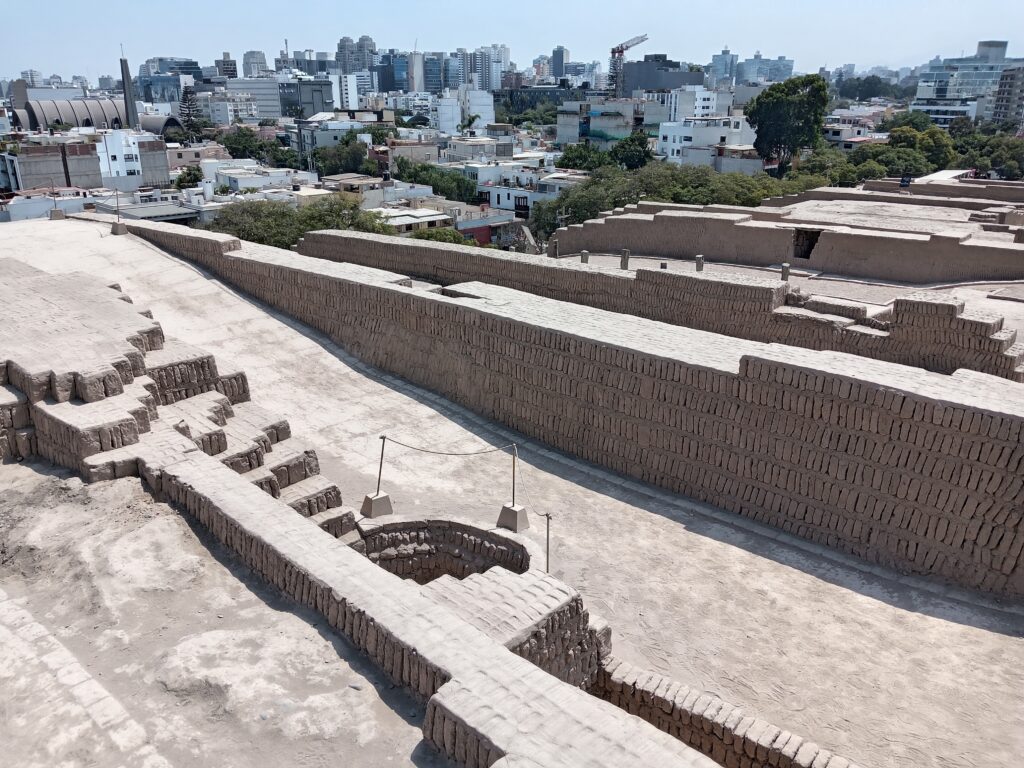
The tour went all around the ancient site, explaining its history and significance. There were two main parts to Huaca Pucllana, one was the pyramid, and the other was a lower area which was more flat. The group started by going around the pyramid, stopping at a few key spots at each level to talk about it and provide information such as what it used for. At the very top there was a nice view of the surrounding urban area, and after having a look around we made our way back down.
On the way to the lower area we passed a garden with a few trees and plants, as well as an enclosure with a few animals in it. After taking a few pictures the group quickly moved on to the last part of the site, from which we had a good view of the pyramid. In that part, there were signs of some rituals that took place, and after talking about that for a little bit more, the guide concluded the tour and the group split. Even though I didn’t remember a lot of the details later on in the day, at the time it struck me as pretty informative, and definitely worth a visit.
I left Huaca Pucllana and took a bus to The National Museum of Archaeology Anthropology and History of Peru, which had an unusually long name. When I got to the entrance, I was directed by the guard to another door, which surprised me, although I didn’t complain, especially since the entree was free.
However, immediately, there was a problem. I was clearly in some kind of gallery regarding the history of Peru and its fight for independence, but for some reason the entrance I walked in through was not the starting point of the gallery. I had to walk around for a few minutes until I found the sight with the number 1 on it, and then follow it in order. Most of the signs were no in English, so I just focused on the few that were without putting too much stress on my brain. It was mainly about the fight against the Spanish crown, and mentioned Simón Bolívar, and overall was an interesting read.
At the end of the history gallery was another door, heading to a little garden, with a couple more rooms in it, which didn’t have any English at all. There were some items on display there, and although I tried to understand it in the beginning, very quickly I lost concentration. The same happened when I came back to what I thought was the main entrance of the museum, and the second part of the building (or just a different building). I took a look around, but didn’t get much. What I did get was related to archeology, and I got it mainly because of the stela, which I recognized from my time in Mexico.
Not far from there, was the Larco Museum, which had a large collection of ancient items on display. There were tours available, although they were not included in the entry fee, so I decided to walk around on my own.
There were several rooms in the museum, where I could learn about different cultures that live in Peru, such as the Wari, and mainly the items and art they made. There was quite a bit of information there, in what felt like a roughly linear timeline, although I wasn’t completely sure about it. The Inka had a place of importance in this museum, and I learned a few things about them, but it was also very clear that they weren’t the only ones, and their fame appeared to be mainly due to their encounter with the Europeans who came to conquer this land.
Unfortunately, just like in the previous museum, here I also found myself losing concentration. I’m not sure if it was just the end of a long day, or perhaps the low light conditions, but I struggled to read the signs and appreciate the art. I pushed myself as far as I could, and took a couple of breaks to sit down and relax, but I still rushed it a bit at the end. After about an hour or so, I headed out of the museum and made my way back to the accommodation.
After a short visit to the historic center, where I visited a couple of free art- focused museums, I headed over to the archaeological site of Pachacamac. I had to take two different buses, and then walk for about half an hour before I got to the entrance. There, I was faced with two options. The first one was to buy the standard ticket, which allowed me to go around the museum by myself and explore part of the archeological site, including the sun temple. The second option was to pay for a bit more for an access to another trail, but that also required me to pay a lot more to hire a guide that will come with me. I wasn’t sure if the price for the guide was per person or per group, and I didn’t ask, but I was a one man group anyway, so it didn’t matter. After thinking about it for a moment, I decided to have the full experience and pay the price (equivalent for almost 5 standard tickets) for the guided tour and the special access.
We started the tour in the museum. According to my guide, it was a relatively recent addition to the Pachacamac site, even though the ruins have attracted people for quite a while. In addition to the many items on display, the museum had signs in both Spanish and English all the way around, which was quite convenient. Being with a guide, I didn’t feel the need to read much there. My guide told me the story, not just about Pachacamac, but about Peru as a whole, and the people who lived and traveled in the area. Again, there was a mention of the Lima, Wari, Chimú people, as well as some other cultures, but the focus was about the Inca.
The tour of the museum was a bit shorter than I thought it would be, and then me and my guide headed out to explore the ruins, and within moments we turned away from the regular path to the special access path. We weren’t deep in the desert, and we could still see more modern urban developments around, but it was a beautiful site. I could only try and imagine what it had looked like in its prime days.
My guide started her explanation about the ruins and the importance of the site, and I was caught by surprise. This was the first time in my travels that I visited an ancient site which was referred to as “the holy land”, both in Latin America and anywhere else. Apparently this was a sacred place not just for the Inca people, but for many others. The vast empire that thrived in this place attracted people from far away, pilgrims who would come to this place, searching for divine guidance and blessings for the future. And while Pachacamac was the most prominent in this site, other deities were also worshipped there.
It was also a place of politics, where different nations had some sort of ancient embassies, which they would visit upon arrival. There were places where the royalty and nobility could reside, as well as shamans and religious leaders. We walked around those sites, and I felt like I’m learning so much more than I expected. And at every turn I could see a slightly different site, where my guide pointed out unique details, some of which I would’ve completely missed out on my own (not to mention it was in a restricted part that I wouldn’t have been able to visit without a guide).
Then we got to the end of the guided tour and I was free to walk around the open path by myself. I walked along for about five minutes until I got to the base of the sun temple, which was one of the main attractions of the site. I made my way up and around the temple, stopping to read the few signs that were spread along the way. On the other side was a great view of the ocean on the horizon, which I absolutely loved. I quickly kept going around the temple, and after about fifteen minutes I was back at the base of it.
I started making my way back to the entrance of the site, and only then realized how big it actually was, and how much ground I covered with my guide. It took a little while, during which I got to have another look at the ruins, and with the help of the guard, I got on a bus right by the entrance to Pachacamac, so I didn’t have to do much walking on my way back to the city center.
To end my educational time in Peru, I also paid a visit to the National History Museum, which was a bit smaller than others that I have visited in other countries. I had a look around, not feeling like I learned anything new, and then I took a quick walk around the garden before saying goodbye to Lima.