
Old Panama, Ancon Hill, Mola Museum, French Square
After spending quite some time in Boquete, and enjoying almost every moment of my stay there, it was time to move on. Another place that was rumored to be great for hiking was El Valle de Antón. Thinking it won’t be difficult to get there, I decided to use public transport (and didn’t even check if an organized shuttle was an option), which ended up taking about 9 and a half hours. Not a recommended way to do it.
When it came to accommodations, I tried different hostels, and both of them were not good. I hoped to go for a third option, but that one canceled on me at the last minute. Unable to find a reasonable accommodation, I left El Valle very quickly. Before leaving, I did hike La India Dormida, which was great, and the views all around town were beautiful, but sadly I was not able to stay there and explore more of it.
After another ride, which thankfully was direct and more comfortable, I got to Panama City. As I was starting to feel tired, I just rested for a few days in an accommodation that seemed to be more or less in the center, at least considering what I was planning to see around the city (the place was more for long-term occupants and not so much for travelers, so it was a pretty lonely experience).
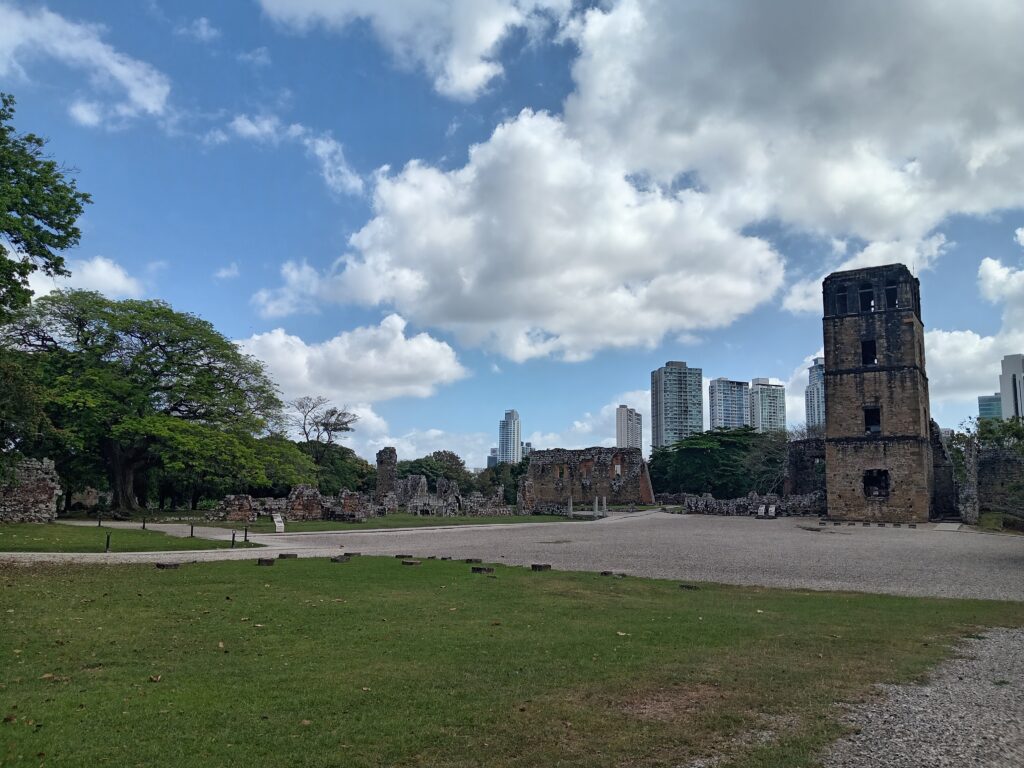
When I felt good enough to go out, the first attraction I visited was Old Panama. After buying the ticket and going through the shop, I was out in the open, a bit confused as to where to go. Thankfully, I was pointed to an open-top cart, in which there was only one other traveler. Not even a minute passed by, and the driver started the cart.
I thought it was a bit odd that we didn’t wait for other people, although I didn’t complain. The ride took a few minutes, during which we passed a few ruins which had signs next to them (and I hoped to get a better look at them later), and stopped at the main plaza, right next to the Old Panama museum.
I walked up some stairs, and found myself in the first part of the museum. In that part, it had some background about the native population of the area, although it very quickly shifted to talk about the Spanish empire and the quest to conquer America. And of course, there was a small section dedicated to funerary urns and burial rites of the aboriginal people who lived in the area before the Spanish came. It was quite informative, and it certainly helped that the signs in English didn’t feel like Google Translate.
Then I went back down, using a different staircase, into a gallery that was more about the life and homes of the people who lived in this area of Panama during the Spanish colonization. It felt more relaxed somehow (not that it’s a bad thing), and I took a bit more time looking through it.
When I was done, I went back outside and straight to the cathedral, which had a tall tower that was used as a viewpoint of the area. Climbing up the stairs, there were signs talking about the history of the cathedral, and the tower, although I didn’t delay on them. When I got to the top, there was a nice view all around, combining the old city with the new city in a way that made me think of Japan, and how that country felt like its nature and cities came together in harmony. The view of Old Panama with the new sights of Panama City was captivating.
Going back down the stairs, I toured around the ruins by myself, and this is where I started to see other people, mainly small groups with a tour guide. At that point, I was no stranger to ruins, but I still enjoyed going around, seeing the signs up close, and reading the signs that were available for more background information.
I went around there for a while before making my way back to the main plaza, and from there I walked all the way to the entrance. This time I could stop by the ruins I saw earlier when the cart took me to the main plaza, which was an extra bit of information that I liked. While the price tag was not the cheapest, it was a fund experience for me.
Then it was time for two excursions which didn’t go well. The first one was the Metropolitan Park, a place that I was not able to get to. I gave it two attempts, couldn’t find the right bus, and had to give up. The second place was the Afroantillano Museum, which I did get to, during opening hours, but it was closed. I didn’t want that to be the end for my time in Panama, so I moved on.
Not very far from the museum was Ancon Hill, which overlooked Panama City. From the starting point of the trail, it was a walk of about half an hour on a paved and easy to follow road. It was pretty easy to go up, with nothing really interesting along the way. Only toward the top there were a couple of viewpoints, and then of course there was the view from the end of the trail. It was a pretty sight which was definitely worth the effort to me. There wasn’t much there, though, and very quickly I made my way back down.
The next place I went to visit in the city was Casco Viejo, which from what I understood was an older part of the city. There I went to the Mola Museum, where I learned about the Guna people, who according to the introduction I got (in English) from one of the staff members, had roots in both Panama and Colombia. The Guna people had been practicing the art of Mola, their style of making textile in a very artistic way (mainly for women’s blouses, at least in the beginning), which they still do today. I was surprised by this traditional style, as it seemed very different from what I’ve seen in Boquete, but then I had to remember the clothes over there have a different origin.
After a short stroll to French Square and looking around the nice view, I walked around for quite a bit until I managed to find the right place to wait for the right bus. That part was really due to the navigation apps on the smartphone not working properly, which was getting quite annoying.
My last stop, not just in Panama City, but in the country of Panama, was the small and relaxed Paitilla Park. After a short walk, I sat down on a bench, shaded by the trees and looking over at the ocean. Once more, it was the time to reflect on yet another adventure.
My time in Panama was mostly, and mostly in Boquete. While my start in Bocas del Toro was unimpressive, Boquete more than made up for it. For the first time in my adventure, this was a place I could see myself living in, for a good while.
Then I moved on, for a short visit to El Valle, a beautiful place which I would have loved to explore more, but the accommodation situation forced me to leave rather quickly.
At the end I made it to the capital, Panama City, where I managed to learn some things about the history of the place and the people, although I wish I could’ve learned more.
The parts of Panama I visited (except Bocas) were definitely worth the visit, and there are more parts that could be explored. Perhaps at a different time, maybe with a partner and a better idea of what to do and how to get there.
With my time in Panama coming to an end, so is my time in Central America. Very early on I found myself confused and unsure where it actually starts. While initially I thought Mexico was the starting point of Central America, according to the internet most of it (and some say all of it) is in North America. Belize, on the other hand, while definitely part of Central America, was not part of Latin America. The more I looked into it, the more complicated it became, and it didn’t take long before it was all too overwhelming and I decided to just let it go.
Mexico, at the end, stood as a contrast to the other countries in the area. It was a lot more educational, mainly about the Mayan (to an wearying extent), and while I did get to explore some of the nature in this country, it was a very small part of my experience. It was also a lot more Americanized, with heavy influences which I didn’t see after I kept going down south.
Belize also stood on its own, and not in a good way. I couldn’t do much there, and at the quick end, before crossing the border to Guatemala, it just felt like I was passing through the country without any memorable experiences.
Guatemala was the first country I visited which was part of both Central and Latin America. For me Central America was mainly characterized by nature, and in particular by the volcanoes. From one country to the next, there was always a volcano to visit, although not all of them were worth it. It was a very nature- focused experience, with incredible views, varying climates, and some mental challenges.
While I did learn some things regarding the history of those countries and the cultures of the people who live in them, it wasn’t as much as I would’ve liked. The museums were few, not always clear, and not always open. Most of the people I came across were kind and happy to help, in both Spanish and English, and I was glad to have come across them, even though I didn’t have any deep conversations with them.
Going from Mexico all the way down Panama took quite some time. It wasn’t always nice or easy, but the good definitely outweighed the bad. While I didn’t enjoy everything, I did enjoy a lot of things. It was an incredible time, but that time has come to an end. With that, I needed to take some time to rest before heading off to my next adventure.