
Regional Historical Museum of Cusco, Inca Museum, Qoricancha, Sacsayhuaman, Q’enqo, Temple of the Moon, Machu Picchu, Taray Viewpoint, Placoyo, Inti Raymi
After leaving Huaraz, I settled in Cusco and for about two weeks the only thing I really did was a walking tour. Something felt off, and I wasn’t sure what. It took me a while, even eventually I did get out and saw what the city had to offer. The first stop was where I bought the ten days tourist ticket, which grants access to sixteen different attractions in and around Cusco, and although I did have the intention of visiting all of them, it was the only way to enter the attractions I was interested in.
I started with the Regional Historical Museum of Cusco. The first floor of the museum had some general information about Peru, mainly the people and cultures that were around before the Spanish, and then some more specific information about the Cusco region. For the most part, it felt like a recap of what I saw and learned about in Lima.
The second floor of the museum was more about what happened after the Spanish arrived, their conquest and evangelism.
Next on my list of museums was the Inca Museum, where I was told it’s not included in the tourist attraction and there was a need to purchase a separate ticket. This museum also had two floors, and despite the name, the first floor was all about cultures and civilizations that existed before the Inca. I made my way up to the second floor, and there, too, there were exhibits which didn’t talk about the Inca.
About half way through this floor there was at last a shift, and I came across a story about the beginning of this grand civilization. That being said, I felt like I didn’t learn much there. There was some information, but overall I thought it could’ve been a lot better, with more exhibits and an in-depth look into the Inca.
With those two museums behind me, I headed to Qoricancha, a site that hosted an important temple at the time of the Incas, which was then destroyed by the Spanish, and later on by an earthquake. Unfortunately, there wasn’t much to admire in terms of the ruins, and not much to learn about in the museum. The signs were lacking, didn’t really mention the site itself, and more or less repeated what I came across in the previous two museums.
Going to explore what is perhaps the most famous archaeological site in the area, I headed over to Sacsayhuaman. After a bit of a walk to get there from the city center, I walked around the site without a guide, and quickly came to the conclusion it was a mistake. There were signs with names of different parts of the site, but no explanation, in any language, and so I wasn’t able to learn anything about it.
What I did was go around the place, looking at the ruins, and getting from one viewpoint overlooking the city to the next. Due to the size of the site, it took about an hour or so before I ended up back at the start point. I went toward a different exit, and next to it was the cave of Chinacana Chica, a detour that didn’t take long to complete.
From there I went to Q’enqo, another nearby archeological site. I passed Q’enqo Chico along the way, where the only real point of interest was another viewpoint of Cusco, and then I got to the proper site.
There was one sign near the entrance, with minimal explanation, and had something about how the site was a labyrinth, at least before the Spanish came and destroyed most of it. It was a short walk through the site, which was a bit interesting and once again made me feel I should’ve gotten a guide for this part of my trip, and then I was out.
Since it wasn’t far from where I was, I added one more stop, to the Temple of the Moon. It took a bit less than twenty minutes to get to the site, which once more had some interest but no clear explanation. I didn’t see any way to go inside the ruins of this temple, but there was a trail which led me to the top of it. After a few minutes I was looking around at the view, sat down for a short rest, and then made my way back to the city.
After going around the city, I had a “VIP” organized tour of the Sacred Valley, which had a few different stops, with each of them being a short visit with minimal explanation. By the time it was over I thought it would’ve been better to just take an independent guided trip to each one of those locations for anyone who wants to try and learn something, but of course that would take more time and more money.
Along with a few other people, I was dropped at Ollantaytambo and from there I went to Machu Picchu Town, and after a bit of sleep I got up early to do a tour of the famous archaeological site. Since I picked Circuit 1, I got the tour with the panoramic view, so I was able to see the whole site from the top and take in the view. The guide was decent, very much following the script he had, which once more resulted in minimal explanation. On top of not learning much, I didn’t find the view impressive, and didn’t think it deserved to be considered one of the Seven Wonders of the World.
For a little while I didn’t feel cheerful and didn’t do much, but then I got to talk with a friendly traveler in the hostel I was staying at, and we decided to go together to Pisac, not for the ruins but simply to check out the small town that we heard about from quite a few people.
Instead of taking the minibus all the way to the town, we got off at what was marked on Google Maps as Taray Viewpoint. It looked like another town nearby, and the view was worth the stop. It was absolutely beautiful, and it stayed beautiful as we made our way along the road on the way to town.
We stopped for coffee at a small place overlooking the area below, and upon asking, the waitress showed us a dirt road that went down to the city, a useful shortcut that also avoided the traffic. Unfortunately, I wasn’t wearing my hiking shoes, as I didn’t think I would need them. On that road, I definitely did.
On this steep and narrow dirt road, It took less than two minutes before I trip. I fell and slid down for a few seconds before I stopped. I managed to get up, and quickly inspected the damage. I had a large scratch on my wrist and a few smaller ones on other parts of my body, but that was it.
Along with my companion for this short trip, I carefully Made my way down. The rest of the road wasn’t as steep, but it certainly wasn’t leveled, and I used a couple of sticks I found as improvised trekking poles for extra stability. I’m not sure it saved us much time, but it was interesting and beautiful. Despite the small pain in my wrist, I enjoyed it a lot.
When we got to Pisac, there wasn’t much there, which I expected. We had a look around the market, ate lunch, and then waited for the minibus to come and take us back to Cusco. It was a short stop, but a great one, and definitely cheered me up.
With Pisac behind me, I figured it was time for a day trip outside the city. I wasn’t looking forward to a ride that can take as much as four hours in one direction, and so I put that off until I was done with everything else.
Looking at the options I had, I chose to go to Placoyo, the smaller mountain of colors. While it took more or less the same amount of driving time as Vinicunca, I hoped it would be more fun (although I couldn’t compare it myself), and according to the internet a less crowded experience.
After a couple hours in the minivan the small group I was a part of stopped in a small restaurant for a modest breakfast, whichI could get enough of it to fill my stomach. It could have been better, with more variety and some vegetables, but it did the job. We finished breakfast and then got back on the road, with the next stop being the beginning of the trail. There was a short bathroom break for anyone who needed it, and then it was time to start the trail of the Palcoyo Rainbow Mountain.
There were three viewpoints along the way, and the guide didn’t rush anyone. If anything, he made sure that everyone was comfortable all the way to the first view point, which took about ten minutes. It took a few more minutes for the entire group to gather together, and at that point the guide wanted to take a group photo of us.
The road to the second viewpoint didn’t present any difficulty, and I quickly got there as well along with a few other members of the group, and we sat there to wait for everyone else to catch up. As the view at that point was better than it was in the first point, it was a nice place to sit and wait.
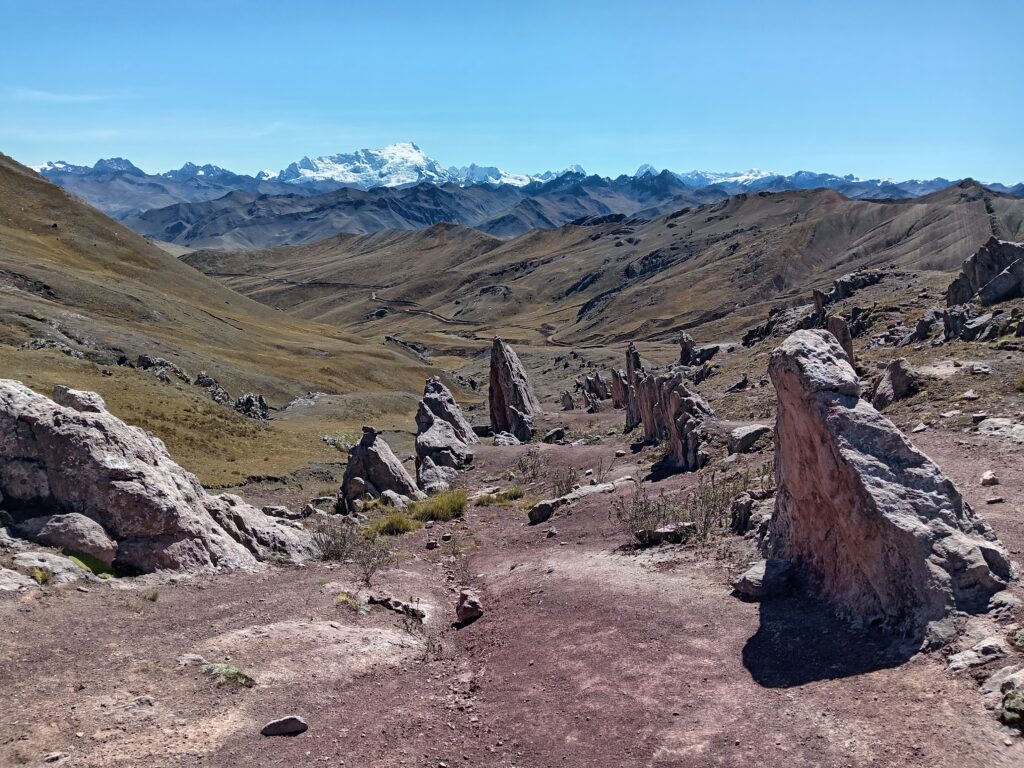
When it was time to get to the third viewpoint, I got a bit confused, as the road seemingly split, and the guide’s explanation was very clear. Since I was a head, I took the left (which I later found out was the right way to go) into a trail that had more of an incline and headed into a group of large rocks which some people referred to as a “stone forest”.
I was climbing more rapidly, along a narrow and twisty path, and the view below got increasingly better. When I got to the entrance of the stone forest I stopped to rest and admire the view, alongside other people from other groups.
I picked my bag and continued along the trail between the rocks. There were arrows pointing the way, but I still needed to be a bit careful. This was also a section of the trail where I was by myself, unable to see anyone ahead nor behind me. After a few minutes though, it was over, and I was at the very top of the trail, where a few other people took some pictures and enjoyed the view. I got to chat with one of them, who had previously been to Vinicunca, and said the lack of crowd at Placoyo made it a better experience for him.
As I made my way down, my group started to show up at the top, and more or less together we made it back to the minivan. We went back to the same restaurant from lunch, which had a bit more variety, and then drove all the way back to Cusco.
The last thing I wanted to see in this city was the Inti Raymi festival, dedicated to the Inka’s sun god. Even though I got to the main square about an hour and a half before anything started, it was already packed and I struggled to find a good spot.
When the waiting time was over, the magic began. It started with a group of dancers coming into the square from one of the corners, dressed in colorful outfits and accompanied by what I assumed was traditional music. Soon enough, another group came from another corner, and then another one, and it became difficult to know where to look and what was the focus of the attention. It was fun, bright, and lively, almost a complete contrast to my experience of the Carnaval in Barranquilla.
Then the music stopped and the talking began. It felt like a more ceremonial part of the festivities, although unfortunately I didn’t understand what was going on. Even though there was an English translator alongside the host, the speakers were too far away and it wasn’t clear what had been said. For the duration of that part, there wasn’t much movement in the square and it felt a bit boring.
It took almost half an hour before the talking stopped and the music picked up again. As the groups of dancers started to make their way out of the square, I thought it was a good time to leave, before the sea of people in the crowd would block every possible exit.
For me, that was the end of this visit to Peru. Even though I only visited three cities, and had some misfortune toward the end, I had a great time in this country, and was left with a feeling that there is a good chance I’ll come back. For me, Peru was everything that Colombia wasn’t, everything I wanted it to be and then some.
What I have seen and experienced was (mostly great), and there is some much more to see, experience, and explore in Peru. The people were helpful, the culture was interesting, and the history was so much more than just the Inka. I learned quite a few things, mainly in Lima, and up in the Andes I got to see unique sighs, some of which I haven’t seen before. It is a country I would recommend without hesitation to anyone who is looking to visit South America and have some incredible experiences.